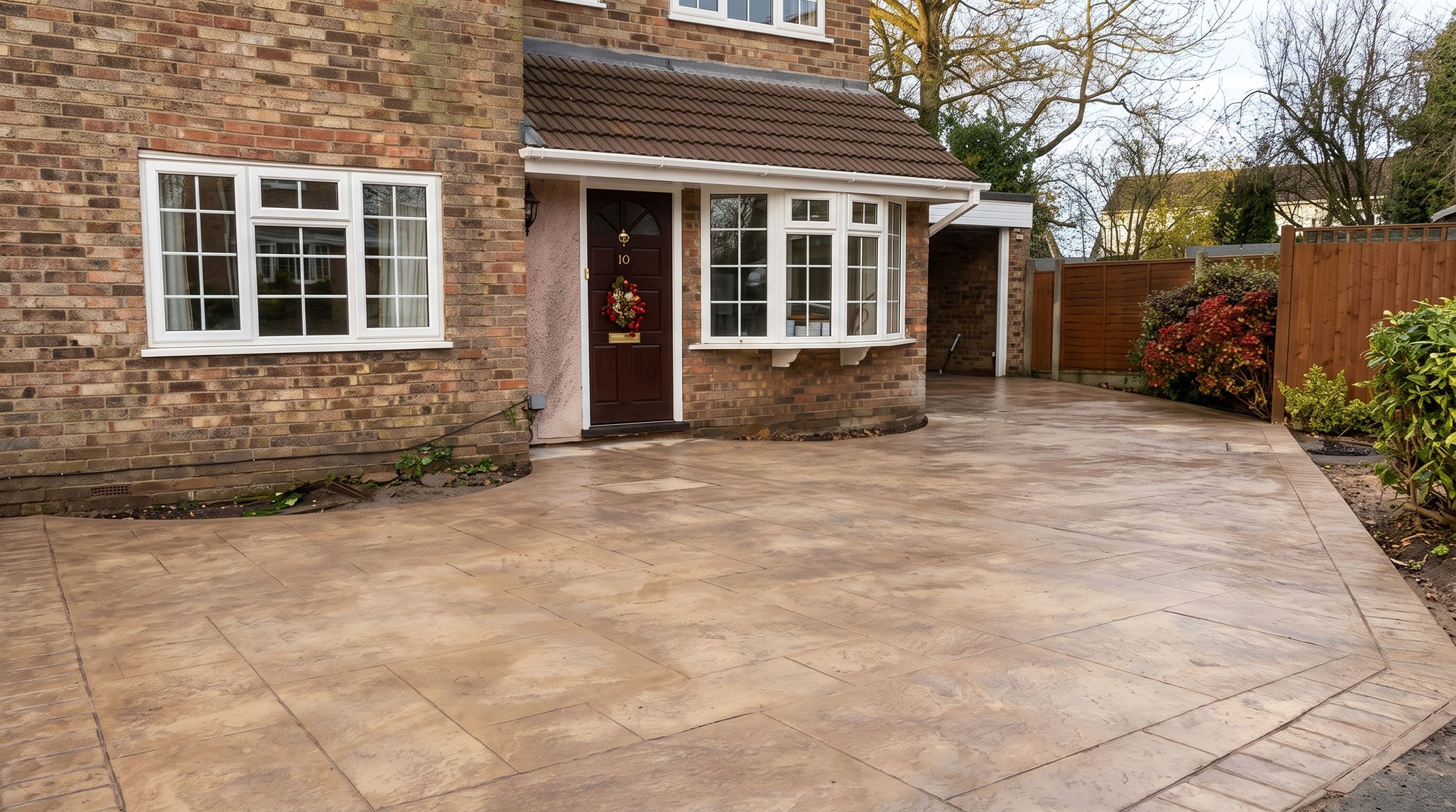
Porcelain · Natural Stone · Block Paved

Patios in Essex

A patio takes more punishment than people expect. It sits still through Essex winters, it holds water against the back of the house if the falls are wrong, and every slab has to stay flat while the ground underneath it moves with the seasons.

We've been laying them across Essex for over 30 years, in porcelain, natural stone and block paving. The materials have changed a lot in that time. What makes a patio last hasn't.

Over 30 Years in Essex
Three decades of driveways across Billericay and the surrounding towns.

Our Own Team, Every Job
The same crew from dig-out to finish. We don't subcontract.

Five-Year Written Guarantee
Every installation covered in writing, not just a handshake.
What We Lay

Porcelain

Outdoor porcelain has taken over a large part of the patio market in the last few years, and for good reason. It's fired at high temperature so it barely absorbs water, which means it doesn't stain the way sandstone does, it doesn't need sealing, and it holds its colour rather than weathering.

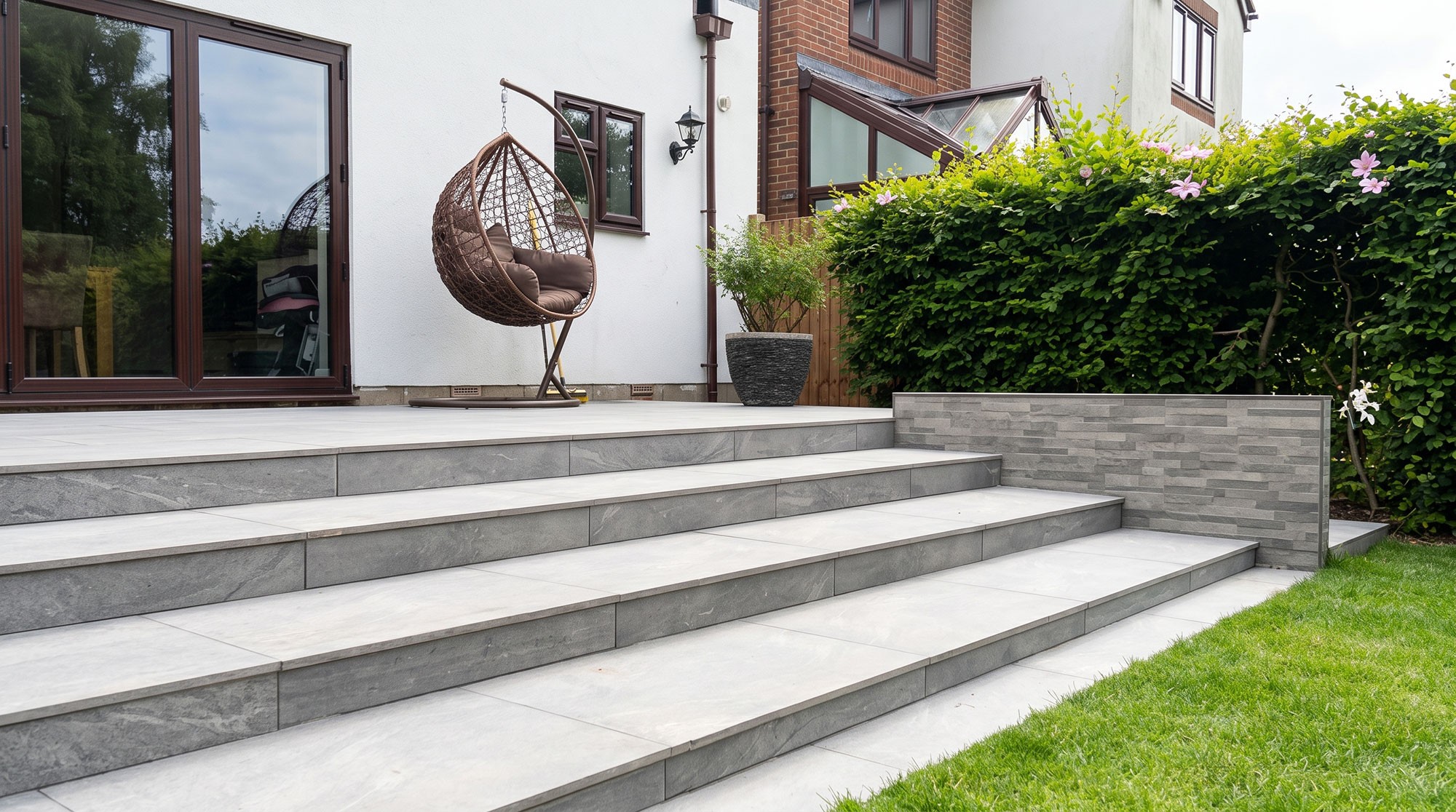
It comes in large formats with clean edges, which suits modern extensions and bifold doors - the patio reads as a continuation of the floor inside rather than a separate thing bolted on.

What people don't get told about porcelain

It's less forgiving to lay than natural stone. Every slab has to go on a full mortar bed, the back of each one has to be primed with a slurry so it actually bonds, and because the edges are so crisp there's nowhere to hide a lipped joint or a level that drifts. It also needs proper blades to cut - chipped edges on porcelain are obvious and permanent.

None of that is a problem when it's done properly. It's the reason a porcelain patio costs more to lay than the slabs alone would suggest, and it's why the cheapest quote is worth a second look.

Natural Stone

Sandstone, limestone, granite and slate all still have a place, particularly on older houses where porcelain can look too sharp against weathered brick.

Indian sandstone is the most common and the most affordable, and it's genuinely attractive - but it's porous. It takes up water, it stains, and it greens over in shade. Sealing helps and needs redoing. Limestone is more uniform and usually darker. Granite is extremely hard wearing and priced accordingly.

Calibrated or uncalibrated

Worth knowing before you buy on price. Calibrated stone has been machined to a consistent thickness, so it lays flat and evenly. Uncalibrated stone varies slab to slab, which means every one has to be bedded individually to bring the surface level. It's cheaper to buy and slower to lay, and if someone is quoting uncalibrated stone at a calibrated price, the difference has to come from somewhere.

What Separates a Good Patio From a Bad One

Nearly every patio that fails early fails for the same three reasons, and none of them are the slabs.

Full bed, not dot and dab

Slabs should be laid on a full bed of mortar, so the whole underside is supported. The shortcut is five blobs of mortar under each slab - quick, cheaper, and the reason patios sound hollow when you walk on them. Those voids fill with water, the water freezes, and the slab cracks or rocks. Porcelain in particular has to go on a full bed.

Falls, and where the water goes

A patio needs a slight fall away from the house so water runs off rather than sitting against the wall. It also needs to finish low enough that rain can't splash or bridge above the damp proof course — as a rule, two courses of brick below it. Get that wrong and you've built a damp problem into the back of the house.

What's underneath

Same as a driveway, on a smaller scale. Dig out, compacted sub-base, then the bedding. Laying slabs onto whatever was already there is the fastest way to a patio that moves in its second winter.


Levels, Steps and Drainage 

Most gardens aren't flat, and most patios need something doing about it. Steps down from a threshold, a retaining wall to hold back a raised lawn, or a change of level between a seating area and the rest of the garden.

We do that work ourselves rather than bringing someone else in - brickwork, retaining walls, steps and edging are all handled by the same team, at the same time.

Drainage matters more at the back than people expect. Water coming off a patio has to go somewhere other than the flower bed it slopes into, and on clay ground that shows up quickly.

Our Process

How We Lay It

Dig out

Existing surface up, ground excavated to the depth the job needs, waste taken away.

1

Sub-base

Compacted hardcore in layers, brought to level with the falls set.

2

Bedding & Laying

Full mortar bed, slabs laid to the pattern, levels checked as we go rather than at the end. Porcelain slabs primed on the back before they go down.

3

Cutting

Cuts made against walls, steps and thresholds with the right blade for the material.

4

Jointing

Joints filled and finished, either brushed in or pointed depending on the material and the look you're after.

5

Edging and cleaning

Edging, steps and any brickwork finished, site cleared, waste taken away.

6

Aftercare

Looking after it 

Porcelain wants a wash down and nothing else. No sealing, no treatment, and it won't change colour on you.

Natural stone wants washing and resealing periodically, and how often depends on how exposed it is and how much shade it gets.

Anything shaded or under trees will green up whatever it's made of. A wash once or twice a year keeps on top of it.


Where We Fit It

We lay patios across Billericay, Wickford, Brentwood, Basildon, Shenfield, Ingatestone, Stock, Chelmsford and the surrounding Essex towns.

See all areas we cover

Get a free quote

Get a Quote for Your Patio

Tell us what you're thinking and we'll come and take a look. No obligation, no pressure, and a written quote you can compare properly.

Call us now on:

01277 651361

Reach out to discuss your requirements, ask questions about installation or schedule a consultation. 

Made & Marketed by
Websites for Tradespeople x Marketing for Tradespeople
keyboard_arrow_up